

Every strategy and guide published by North Shore is backed by the board-certified expertise of our Co-Founders. With decades of combined experience in holistic admissions, Amy and Debbie ensure our guidance is objective, unbiased, and focused exclusively on your student's best fit.
Who Should Edit a College Essay? Two Readers, Not a Committee
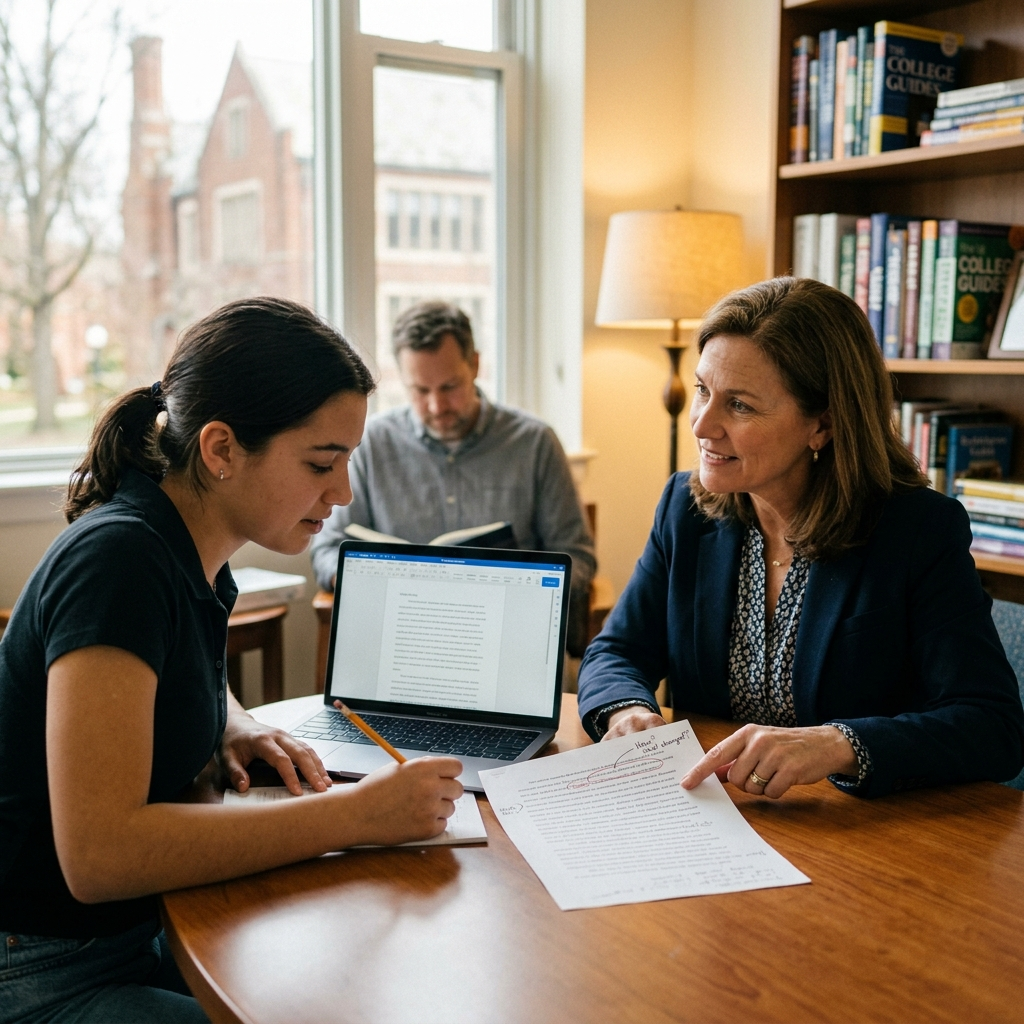
Our recommendation: one primary adviser, one fresh-eyes reader, and the student writes every revision. The adviser identifies problems with structure, clarity, and reflection and asks questions. The second reader catches confusion and errors. Nobody supplies sentences. Yale's published essay guidance tells applicants they keep control of their essays and that the essays should retain their own voice. Caltech says it is less interested in polished performance than in genuine insight. When more adults join, the essay tends to get more polished and less like the student who wrote it, which is the opposite of what those offices say they are reading for.
By late September the personal statement in a senior's household has often been read by a parent, an English teacher, a counselor, sometimes a consultant, sometimes an older cousin with an opinion about Harvard. Each reader improves something. The essay gets tighter, cleaner, more reflective. And the growing list of approvals gets treated as evidence that the essay is getting better, because nobody has told the household what the essay is being read for.
The answer sits in the admissions offices' own published guidance for the 2026 to 2027 cycle. Yale tells applicants their essays should retain their own voice. Caltech says it is less interested in polished performance than in genuine insight. Stanford asks for the applicant's own words. That sets a stopping point, and the problem we watch for most closely in October is not an under-edited essay but an over-edited one: a strong student draft that has passed through so many capable adults that nobody noticed how much of the student's language disappeared. This post explains how that happens, what the reader compares the essay against, and the narrower question of when October editing is still the right call.
Authorship by Accumulation: How a Student's Essay Stops Sounding Like the Student
Outright adult authorship is the easy case. Common App's Fraud Policy expressly covers intentionally presenting another person's thoughts, language, ideas, or expressions as the applicant's own original work. Brown and Yale both affirm that definition on their admissions sites. That version is rare in the applications we see. The version we see constantly is quieter.
A parent changes three sentences. The English teacher fixes the opening. The counselor thinks the conclusion needs more reflection. A consultant trims eighty words. Someone replaces an adjective. An AI tool smooths the transitions. Every change is individually defensible, and at no point did anyone write 650 words for the student. But the student's choices have been swapped, one at a time, for the collective preferences of the adults in the room. We call it authorship by accumulation. It is especially easy to miss where several strong editors are available, because no single edit looks inappropriate. The problem only shows when you look at what all of the edits did together.
The essay that results is often better by conventional writing standards and worse as an application document: more elegant, more organized, more concise, and less revealing.
Student draft:
“I rewrote the first sentence of my history paper eleven times and then realized I had spent forty minutes avoiding sentence two.”
Adult-edited version:
“My perfectionism often prevented me from making progress, but I eventually learned that growth requires accepting imperfection.”
The difference: The behavior proves the point in the student’s version. The adult version names the trait and supplies a tidy conclusion.
The edited version in a pair like that usually reads as more sophisticated. It also reads like a great many other essays. The student's version gives the reader a person. We walked through the same trade at the paragraph level in College Essay Opening Paragraph: Before and After the Read. In our experience specificity sounds less impressive than abstraction and does more work, because the reader is not evaluating which member of the household writes best.
Who Should Edit a College Essay? One Adviser, One Fresh-Eyes Reader
Yale's published advice is to share the essay with at least one or two people who know the student well, and it names a parent, teacher, counselor, or friend. That is a floor. Our recommendation is a ceiling: two roles, not a committee.
Everyone else can stand down. The essay does not need unanimous adult approval to be finished. Within the two roles, the line that matters is between identifying a problem and solving it. The adult identifies the problem. The student solves it.
The last row is the trap. The adult's sentence is often better. The student hears it, says "yeah, that's good," and pastes it. Fifteen repetitions later nobody has technically written the essay for the student, and a meaningful share of the language is no longer the student's. Adults should leave comments, not fingerprints.
The two roles, the twelve questions, and the tests below are on one page in The Two-Reader Essay Protocol.
What Yale, Caltech, and Stanford Say They Are Reading For
This is not a consultant asking families to accept rough writing. The offices themselves have written the standard down.
Notice what none of those asks for: adult-level literary polish. The essay has to be clear, purposeful, and free of careless errors. Beyond that, better writing and a better college essay are not the same thing.
There is a second reason voice matters, and Yale's admissions officers have addressed it directly on their own podcast. In the episode "Essays: What Works," officer Hannah warns that an essay edited and edited by a bunch of people can lose the applicant's voice, and that while sharing the essay is fine, no one should be rewriting it for the student. Officer Mark adds that the essay is not the place to show off vocabulary or complex sentences, because the goal is for the reader to understand the 17-year-old who wrote it. And the episode closes with the two marks of an unsuccessful essay: it does not sound like it was written by a 17-year-old, and it does not mesh with the rest of the application. The issue is not that an essay sounds too good. It is that the diction, reflection, and phrasing no longer plausibly match the student whose other writing appears in the same file. For how a reader moves through that file, see An Inside Look at How College Applications Are Evaluated.
That gives the household a better final review than another round of line editing, and Yale's officer Keith supplies the question: instead of asking a reader whether the essay is great, ask whether it sounds like me. The student reads, in order, the personal statement, two or three short answers, several activity descriptions, and one school-specific essay, and asks whether these could plausibly have been written by the same person. Not the same tone, since a 50-word box and a 650-word essay do different jobs. The same mind, the same sense of humor, the same vocabulary level. Then one more question: is there anything in the essay you kept mainly because an adult liked it?
AI Policy Differs by College: Common App, Yale, Brown, Caltech
AI belongs in this post, not in a separate warning, because it raises exactly the same question as the six human editors: who originated the thinking and the language being submitted under the student's name? We took up the narrower version of that question in Can AI Write Your College Application Essays? The published rules differ, and a use allowed at one college is not necessarily allowed at another.
Caltech also gives applicants the cleanest test we have seen: ask whether it would be ethical to have a trusted adult perform the same task. A teacher can check spelling. A teacher should not draft the essay for the student to modify. Read that test backwards and it covers this entire post. AI is adult editor number seven. Our recommendation is simpler than any single policy: the student does not submit AI-generated language as their own, does not use AI to outline or draft, and checks the current policy of every college on the list before using AI for anything beyond proofreading. Many colleges have no published policy at all, which is a reason for caution, not permission. The reason a reader can usually tell is the subject of Why Authentic College Essays Matter More Than Ever in the Age of AI.
When October Editing Is Still the Right Call
The presumption in October is that the personal statement is done. It is a presumption, not a rule, and the exceptions are specific. A factual error gets fixed. A passage two readers found confusing gets fixed, by the student. A structural problem that leaves the reader unsure what happened gets fixed. And an essay that no longer sounds like the student, usually because accumulation already happened, gets rebuilt from the student's own earlier draft rather than polished further. If the earlier draft was built on the wrong idea to begin with, Most Students Brainstorm the Wrong Personal Statement is where to start. That last case calls for going backward, not forward, and it is the one where a reader who has seen hundreds of files earns their keep, because the household usually cannot tell whether the line has been crossed.
What does not trigger another round: "I think this adjective could be stronger." "The opening could be a little more elegant." "Your uncle likes version three better." "The English teacher has one more thought."
We will not tell you that supplements decide more files than the personal statement. There is no evidence for that across schools, and Caltech's own review page says no single essay determines a decision. Yale's officers go further on their podcast. Mark says that for many admitted students the essay is not among the most important parts of the file, and that for most students its greatest effect is tying the other pieces of the application together. An essay that has been polished until it no longer matches the activities list and the short answers has lost the one job Yale says it does best.
The claim we will make is narrower and more useful. Once the personal statement is accurate, clear, student-authored, proofread, and ready to submit, stop spending October making it marginally prettier. Put that hour into an unfinished supplement, the activities section, or an application detail that still needs real work. Stanford says its short questions and essays exist to get to know the applicant as a friend, future roommate, and classmate; those pieces cannot be borrowed from the personal statement, and a "why us" essay that could be sent to another college is a bigger problem than a fourth paragraph that could be five words shorter. [LINK PLACEHOLDER: "why us" supplement post, pipeline post 6, once live.]
The test that tells the student which side of the line the essay is on takes five minutes. Read it aloud. Every place the student naturally substitutes a different word, circle it. Every sentence the student has trouble saying naturally, circle it. Every line that produces "I would never say that," delete or rewrite in the student's own words. Proofread once. Close the document.
What Your Student Should Do
Three moves, in order.
Name the two readers and dismiss the rest. One primary adviser, one fresh-eyes reader, chosen this week. Everyone else who has been sent the doc gets thanked and removed from the share list. The student sends that message, not the parent, because the student is the one who has to defend the essay's voice. New readers produce new opinions, not new information.
Run the read-aloud test and the cross-application test before any further edit. The student reads the personal statement aloud, circles every substitution and stumble, and rewrites only those lines in their own words. Then reads three short answers and the activities descriptions back to back and confirms they sound like the same person. If the essay fails, the fix is the student's earlier draft, not another polish.
Proofread once, lock the document, and move the hours. Once the essay passes, the student proofreads once for errors and closes it. The next block of time goes to the school-specific supplements, starting with the earliest deadline on the list, and to the activities section.
The calendar wrinkle: Common App's applicant support guidance says students are allowed unlimited edits to the personal essay after their first application submission. That is a technical capability, not an editing strategy, and the version already sent to a school is the version that school reads. Treat the first application deadline as the essay's real lock date unless a genuine problem surfaces afterward. "Common App lets me keep changing it" is not the same as "I should keep changing it." For what a first submission actually does, see When to Submit the Common App: What an August Submission Does.
You don't have to navigate the complexities of college admissions alone. Whether you are aiming for the Ivy League, a top-tier public university, or a highly selective major, our expert counselors are here to help you craft a personal brand that stands out.