


Every strategy and guide published by North Shore is backed by the board-certified expertise of our Co-Founders. With decades of combined experience in holistic admissions, Amy and Debbie ensure our guidance is objective, unbiased, and focused exclusively on your student's best fit.
A student does not have to take calculus in high school to apply to Michigan Engineering, Illinois Grainger or Purdue Engineering. That is not the same as saying calculus does not matter. All three name it, in their own published guidance, as the math course they want to see when the high school offers it. Most families hear about that language for the first time in junior year, when a student names a program and the counselor pulls up a schedule that cannot get to calculus. The reaction is nearly always the same: nobody told us.
The answer sits in two places. The high school's own math flowchart shows every branch and every gate, and the admissions pages of the programs themselves state how much calculus matters and, more usefully, where it does not. Read together, they answer the question. What they cannot answer is whether a particular eighth-grader should accelerate, and that is where this post ends.
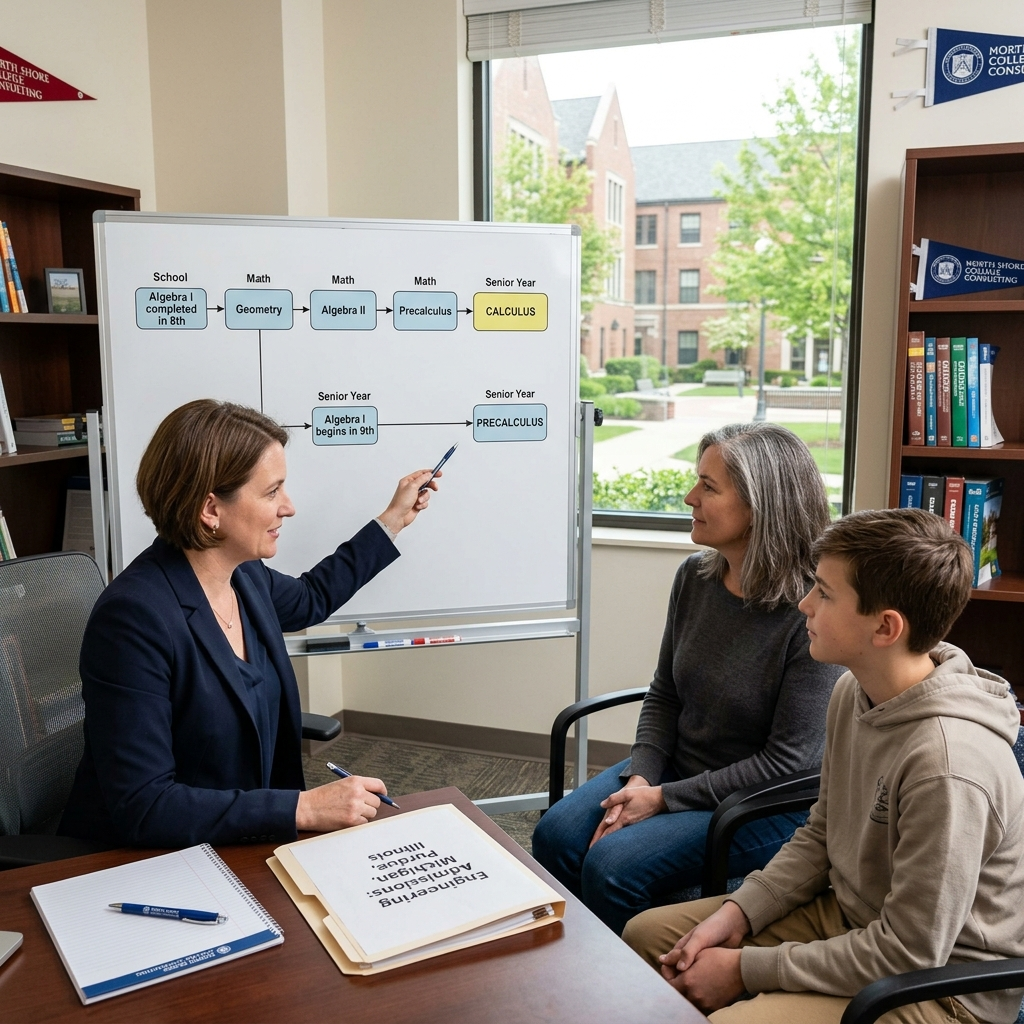
In a traditional sequence, the gap between taking Algebra I in eighth grade and taking it in ninth looks like one course. Four years later it looks like this.
That is an illustration, not a national course map. Some districts run Integrated Math I, II and III. Some offer a compressed Honors Algebra II and Precalculus course. Some send students into BC Calculus directly from an accelerated precalculus. Your district's sequence is the one that counts.
The arithmetic, though, holds in nearly every version. A student who begins Algebra I in ninth grade and follows the five-course sequence one course per year reaches precalculus, not calculus, in twelfth grade. Reaching calculus requires a later change to the sequence that the high school permits. Eighth-grade placement does not decide the senior transcript. It sets the ceiling unless someone raises it later, and raising it later has a cost this post gets to below. This is the same logic we laid out in Freshman Year Will Be a Third of Your Child's Transcript: the early years are not a warm-up; they are the record.
Two details worth knowing. The eighth-grade course does not vanish from the record: Purdue states that high school level coursework completed in middle school counts toward its four-year math requirement when the course appears on the high school transcript or the progression is apparent from it. And the essay analogy is exact. An application essay can be rewritten in October of senior year. A four-year math sequence cannot.
The one question to ask at the open house. Not "is this a good math class." That gets a reassuring answer and no information. Ask: if my student begins ninth grade in this course and does not use summer school or double up, what is the highest math course available in twelfth grade? That question moves the conversation from the next course to the whole chain. The full set of gate questions is further down.
Parents hear a lot of loose language about calculus and selective admissions. The published language is more useful, and it differs by program and sometimes by college within the same university.
Two things the table cannot hold. First, why "highly recommended" carries weight at Michigan: the College of Engineering reports that for fall 2025 it admitted 14 percent of 28,740 applicants, with a median high school GPA of 3.9. That figure is program-specific and college-reported. Second, what Purdue does with the answer once a student arrives. Its standard first-year engineering Calculus I is described in the course listings as designed for students who have not had at least a one-semester calculus course in high school with a grade of A or B. Purdue sorts its admitted engineers on day one by exactly the question this post is about.
None of the three engineering programs says no calculus, no admission. All three give calculus explicit weight in their current guidance. Both halves of that sentence are provable, and both matter. For how a reader weighs a course choice like this against the rest of the file, see How Admissions Officers Read a Transcript: What Families Miss.
This is where blanket advice gets sloppy, and where a parent can overcorrect in either direction.
Computer science depends on which college houses the major. At Illinois, the standalone CS major sits inside Grainger, so Grainger's published calculus preference applies to CS applicants. And at Illinois the CS decision has to be made before enrollment: the Grainger FAQ states that Computer Science, CS plus Bioengineering and CS plus Physics are closed to internal transfer for anyone who entered the university as a first-year student. There is no route into Illinois CS from the inside. At Purdue, the CS admissions page asks for the most rigorous curriculum available and lists four years of math, but it does not single out calculus the way the Engineering page does. Purdue's general guidance for technical programs names precalculus and AP or IB calculus as good choices without elevating either to a criterion. We would encourage a serious Purdue CS applicant toward the strongest appropriate sequence. We would not describe high school calculus as an official Purdue CS floor, because Purdue does not.
Business is more varied still, and the mistake runs the other way. Michigan requires four units of math for Ross applicants and states that calculus is not a requirement. Illinois Gies admits every first-year student as Business Undeclared, requires the same 3.5 years of math including trigonometry or higher that Grainger does, and does not name calculus in its current guidance. Purdue Daniels goes further than either in its preparation advice, encouraging precalculus and calculus because calculus is in its degree plans, but that is advice about readiness for the coursework, not a published high school requirement for admission.
The takeaway is not that business applicants need calculus, and it is not that CS applicants do. It is narrower and more useful: read the admissions guidance for the actual college and program, because the answer changes by university and by college within a university, and do not close off a rigorous senior-year math option at 13 on the strength of a category. The same rule drives our read of UT Austin, where the major decision is the admission decision, and it is the reason Decoding the College Major Puzzle starts with the college, not the major name.
These go to the math department, not the general open-house session. The first is the one above; the rest find the gates.
For an integrated curriculum, do not translate Integrated Math I, II and III into Algebra I, Geometry and Algebra II yourself. Ask the department to show which current placements lead to calculus by senior year and what later entry points exist.
When we meet a tenth-grader interested in engineering who is no longer on a calculus path, the assumption is that it can be fixed over the summer. Sometimes it can. Each route has a cost that the published admissions language does not mention.
Summer acceleration compresses nine months of foundational material into six or eight weeks. The question is not whether the student can earn the credit but whether the student enters the next course ready. In our advising, Algebra II is the course we are most cautious about compressing, because gaps in functions, exponents, logarithms and algebraic manipulation resurface in precalculus and calculus. That is a readiness judgment, not an admissions rule. Doubling up on Geometry and Algebra II preserves a full year of instruction but changes the entire year's workload for a student also carrying honors science, a language and serious activities. A compressed course the school designed for acceleration is usually the cleanest option, and its availability is entirely school-specific. How a sophomore's schedule absorbs a second math course is the kind of sequencing decision we walk through in Sophomore Year College Planning: The Sequence Decides Senior Year.
Outside coursework is the option to verify hardest, because credit and placement are separate questions. We have watched students complete an online Geometry course, receive elective credit, and stay exactly where they were in the sequence. If the goal is acceleration and the course will not change placement, it does not accomplish that goal. Before enrolling, the student should get written answers from the high school: does this course or provider require advance approval, does completing it satisfy the prerequisite for the next course, is there a minimum grade, is there a separate placement exam, does it earn credit, placement, or both, and who makes the final placement decision.
And there are students who should stay where they are. A student who depends heavily on tutoring to keep pace, rushes multi-step problems, or is developing real anxiety around math gains nothing from acceleration. The schools say as much. Michigan Engineering tells applicants to challenge themselves in a demanding curriculum, whatever that means in their own school. Grainger says to challenge yourself given what is available while remaining successful inside and outside the classroom. Purdue reads grades in the intended major's subjects alongside curriculum strength. Rigor and performance are not competing signals; the reader sees both. There is no admissions prize for a C in a course a student was not ready for. There is also no reason to let a student who is ready for more drift into a sequence that quietly removes options. Those are two different mistakes. The flowchart shows where the branches are. It cannot tell you which branch this particular student belongs on, and that judgment, not the chart, is the work.
Not as an absolute high school admission requirement in the current guidance from any of the three. Michigan Engineering requires trigonometry or precalculus and calls calculus highly recommended. Illinois Grainger says calculus is preferred and physics expected when the high school offers them. Purdue First-Year Engineering says its holistic review places particular emphasis on calculus when it is available. A student applying from a high school that offers calculus and stopping at precalculus is presenting a transcript below what those programs say they prefer. How much that weighs in an individual decision is not published.
Michigan Engineering states on its own admissions advice page that it will never penalize a student for a class the high school did not offer. Illinois Grainger's calculus preference and Purdue Engineering's calculus emphasis are both expressly conditioned on the course being available at the high school. All three describe reviewing rigor in the context of what the school provides. The student should take the highest math the school offers and, where dual enrollment is an option, ask the counselor whether a college calculus course would appear on the high school transcript.
There is no universal answer, and the schools say so. Michigan Ross requires four units of math and states explicitly that calculus is not a requirement; the math record is viewed holistically. Illinois Gies requires at least 3.5 years of math including trigonometry or higher and admits all first-year students as Business Undeclared; its current admissions guidance does not name calculus as a separate requirement or preference. Purdue's Daniels School of Business encourages precalculus and calculus as preparation because calculus is in its degree plans, but it does not state that high school calculus is an admission requirement.
Yes, but not by following a conventional Algebra I, Geometry, Algebra II, Precalculus sequence one course per year; that path ends at precalculus in twelfth grade. Reaching calculus requires a change the high school permits: a summer course the school accepts for placement, taking Geometry and Algebra II in the same year, or a compressed Algebra II and Precalculus course where one exists. Which routes exist, what they require, and when the request must be made are all school-specific. The student should ask the math department for the entry points and the deadlines by name.
It means the program has told applicants, in its own published criteria, which course it wants to see when the applicant's high school offers it. Preferred is not required: a file without calculus is still read, and the language is conditioned on availability. But readers evaluate rigor in the context of what the school offers, so preferred carries weight when the course was available and the student chose something else. Illinois Grainger uses that word; Purdue First-Year Engineering says particular emphasis; Michigan Engineering says highly recommended. None of the three publishes how much weight it carries in a given file.
What Your Student Should Do
Three moves, in order.
Trace the flowchart before the open house. Your student pulls up the high school's math sequence chart, finds the current course, and follows every route through twelfth grade, circling each place the path branches. If one branch reaches calculus and another does not, that branch point is the item to ask about. For a seventh-grader, do this with the middle school's placement guide, since the split usually happens there. One evening is enough, and the Math Sequence Map gives you the grid to do it on.
Ask what controls each branch. The seven questions above go to the math department. The one to end on: based on what you are seeing from this student now, which placement gives appropriate challenge without putting them in over their head. That is a better conversation than demanding acceleration, and it is the one the department will answer honestly.
Get the placement answer in writing before any outside course. If acceleration through a summer or online course is on the table, your student emails the department chair or counselor before enrolling with the six placement questions above. The reply is the document to keep. No enrollment until it exists.
One calendar note. The deadline to request a placement change or preapprove outside coursework is a school-specific date, and in our experience it frequently falls well before summer. Ask for it by name at the open house and put it on the calendar that night. Where this sits in the larger four-year plan is mapped in College Admissions Strategy by Grade Level.
You don't have to navigate the complexities of college admissions alone. Whether you are aiming for the Ivy League, a top-tier public university, or a highly selective major, our expert counselors are here to help you craft a personal brand that stands out.